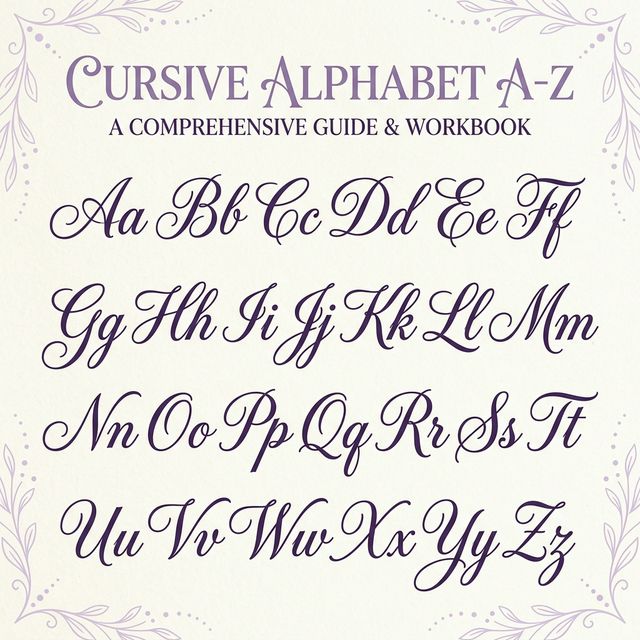
Understanding the Cursive Alphabet
The cursive alphabet consists of 52 letter forms — 26 lowercase and 26 uppercase — each designed to be written with a flowing, connected motion. Unlike printed (manuscript) letters, which are drawn with separate strokes and lifted pen movements, cursive letters are formed with continuous strokes that naturally lead into the next letter.
The word "cursive" itself comes from the Latin currere, meaning "to run." This etymology perfectly captures the essence of the style: letters that run together, creating a smooth, unbroken flow across the page. This connected nature is what makes cursive faster than print once you have learned it — your pen lifts far less frequently.
While the basic Latin alphabet remains the same, the shapes of many cursive letters differ significantly from their printed counterparts. Printed "b" and cursive "b" share the same identity but look quite different. Some letters — particularly uppercase F, G, Q, S, and Z — are almost unrecognizable to someone who has only learned print. This is both the challenge and the charm of cursive: it is familiar yet distinct, functional yet artistic.
Lowercase Cursive Letters a–z
Lowercase letters form the backbone of your cursive writing. They can be organized into groups based on their starting strokes, which makes learning them more systematic and efficient.
The Undercurve Group
Letters: a, c, d, e, g, i, l, o, q, t, u
These letters begin with an upward curve from the baseline. The cursive a is a foundational letter: start with an undercurve to the midline, loop back into a round body, then exit with a connecting stroke. Once you master "a," letters like c, d, g, o, and q come more naturally because they share the same opening motion. The key difference is the exit: "d" extends tall, "g" drops below the baseline, and "o" closes its loop fully.
The Overcurve Group
Letters: m, n, v, x, y, z
These letters begin by curving upward and over, then dropping back down — like drawing a hill. The cursive m is the most recognized: three evenly spaced humps connected by smooth curves. The cursive n is simply two humps. Focus on keeping the humps uniform in height and spacing. Letters y and z extend below the baseline with descending loops.
The Loop Group
Letters: b, e, f, h, k, l
These letters feature prominent loops. The cursive l is one of the simplest letters in the entire alphabet — a single tall loop from baseline to top line and back down. The cursive b is a tall loop that transitions into a round bottom. The cursive f is unique because it loops both above and below the baseline, making it one of the trickiest letters to master.
The Remaining Letters
Letters like j, p, r, s, w have their own distinct motions. The cursive "r" is particularly important to study because its form — an upward stroke with a small shoulder bump — looks nothing like a printed "r." The cursive "s" is also different: it resembles a small, elongated wave rather than the two-curve printed form.
Uppercase Cursive Letters A–Z
Uppercase cursive letters are larger, more decorative, and serve as the visual "opening statement" of a word. Some closely resemble their print versions while others are completely different.
Letters Similar to Print
C, O, P, S, U, V, W — These uppercase cursive letters are recognizable variations of their printed forms. Cursive C, for example, is essentially a larger, slightly more flourished version of printed C. These are the best starting points for learning uppercase cursive.
Letters Different from Print
B, D, F, G, I, J, Q, T, Z — These letters have cursive forms that differ substantially from print. The uppercase cursive F looks like a tall, looping figure-eight. The uppercase G starts with a printed-G-like shape but adds a descending horizontal bar. The uppercase Q often resembles a large number 2, which surprises many learners.
Letters with Extra Flourish
A, E, H, K, L, M, N, R, X, Y — These fall in between. They have recognizable similarities to print but add cursive-specific flourishes, loops, or entry strokes. Uppercase A, for instance, begins with a distinctive upswing that does not exist in the printed form.
Different Cursive Styles Compared
There is no single "correct" way to write cursive. Throughout history, several standardized systems have been developed, each with its own philosophy and letter forms:
| Style | Origin | Characteristics | Best For |
|---|---|---|---|
| D'Nealian | 1978, Donald Thurber | Simplified, rounded letters; smooth transition from manuscript | Beginners, children, schools |
| Zaner-Bloser | 1888, Platt Rogers Spencer | Traditional forms; distinct difference between print and cursive | Traditional education, formal writing |
| Spencerian | 1840s, Platt Rogers Spencer | Ornate, flowing; elaborate flourishes and varying thick-thin strokes | Calligraphy, artistic expression |
| Palmer Method | 1894, Austin Palmer | Simplified Spencerian; muscular arm movement instead of finger movement | Speed writing, business use |
| Getty-Dubay Italic | 1976, Barbara Getty | Italic slant; partially connected letters; very legible | Adults learning or relearning cursive |
For most beginners in 2026, D'Nealian or Getty-Dubay Italic are the most practical starting points. They prioritize legibility and simplicity while still teaching the connected letter-forming skills that define cursive.
Tips for Learning the Cursive Alphabet Faster
- Learn in stroke groups, not alphabetical order. Grouping letters by similar starting strokes (as described above) is far more efficient than learning A, B, C, D in order, because your hand practices the same motions repeatedly.
- Practice with real words immediately. As soon as you know a handful of letters, start writing simple words with those letters. For example, once you know a, c, e, and t, you can practice "cat," "ace," "eat." This contextualizes your practice and builds connection skills simultaneously.
- Use lined paper with a dotted midline. The midline is your best friend for maintaining consistent letter height. Do not skip this — even experienced writers benefit from guidelines.
- Copy text you enjoy. Favorite song lyrics, poems, or quotes make practice feel less like homework and more like recreation. The goal is consistent practice, and enjoyment sustains consistency.
- Practice before bed. Studies on motor skill learning suggest that your brain consolidates procedural memories (like muscle movements) during sleep. A 15-minute practice session before bed can be more effective than 30 minutes in the afternoon.
Practice the Cursive Alphabet with Our Tools
We built free tools specifically to help you master these letter forms:
- Cursive Alphabet Reference — A visual reference showing every letter of the cursive alphabet in multiple font styles. Compare different cursive systems side by side and see exactly how each letter should look.
- Cursive Worksheet Generator — Generate custom practice sheets with any words, sentences, or the full alphabet. Choose your font, size, and line spacing, then print. Perfect for structured daily practice.
- Cursive Generator — Type your name and see it in beautiful cursive instantly. The most motivating way to start your practice journey.
Mastering all 52 letter forms is a journey, not a sprint. Give yourself 4–6 weeks of consistent practice, and you will have a handwriting skill that serves you for life.