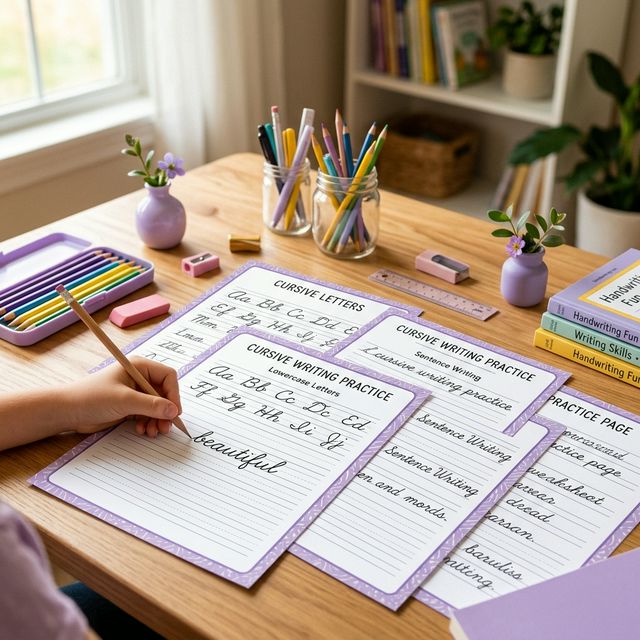
Why Cursive Worksheets Are Still the Best Way to Learn
In a world of apps and digital tools, it might seem outdated to recommend printed worksheets for learning cursive handwriting. But neuroscience consistently supports the pen-and-paper approach.
A landmark 2012 study by Karin James at Indiana University used brain imaging to show that the act of physically forming letters by hand activates neural pathways in ways that tracing on screens does not. The resistance of pen on paper, the fine motor coordination required, and the tactile feedback from the writing surface all contribute to deeper learning.
More recent studies (2023–2025) have reinforced this finding: handwriting practice on paper leads to better letter recognition, improved memory retention, and faster skill acquisition compared to digital alternatives. The physical worksheet remains the gold standard for building cursive skills — which is exactly why we built a free tool to create custom ones.
Types of Cursive Worksheets Available
Not all cursive writing worksheets are the same. Understanding the different types helps you choose the right practice material for your level:
Letter Tracing Sheets
The most basic type. Each letter is printed in a light gray or dotted outline, and the learner traces over it with a pen or pencil. These sheets build muscle memory for correct letter formation. Best for absolute beginners and young children just encountering cursive for the first time.
Letter Practice Sheets
These provide one or two model letters at the left of each line, followed by blank space for independent practice. The learner references the model and reproduces the letter on their own. This is a significant step up from tracing because it requires the brain to plan the movement independently.
Word Practice Sheets
Once individual letters are comfortable, word-level worksheets introduce letter connections. Words are presented in model form, and the learner practices writing them. These sheets are crucial because connecting letters is the defining skill of cursive — and it is a skill you can only build by practicing full words.
Sentence and Paragraph Sheets
The most advanced worksheet type. Entire sentences or paragraphs are provided for copying practice. These build endurance, rhythm, and real-world application. They also help learners develop a consistent personal style as they stop thinking about individual letters and start focusing on the flow of complete thoughts.
Age-Appropriate Cursive Worksheet Guide
| Age / Level | Worksheet Type | Focus | Duration |
|---|---|---|---|
| K–2 (5–7 years) | Letter tracing only | Large letters, basic strokes, pencil grip | 10 min/day |
| 3–5 (8–10 years) | Letter practice + word practice | All 52 letters, basic connections | 15 min/day |
| Middle School (11–14) | Word + sentence practice | Speed, consistency, personal style | 15–20 min/day |
| Adults | Sentence + paragraph practice | Fluid writing, practical application | 15–25 min/day |
How to Make Custom Cursive Worksheets
Generic worksheets work, but custom worksheets are far more effective because they let you practice with words and sentences that are personally relevant and motivating.
Our Cursive Worksheet Generator makes it easy:
Enter Your Text
Type any text — your name, a favorite quote, vocabulary words, or specific letters you are struggling with.
Choose Settings
Select your preferred cursive font, font size, and line spacing. Larger sizes with wider spacing work best for beginners.
Generate and Print
Click generate to see your worksheet preview, then print it on standard letter-size paper. Practice with real pen and paper for the best results.
The ability to create custom worksheets means you never run out of fresh practice material. If you are struggling with connecting "r" to "i," you can create a worksheet full of words containing "ri" — like "write," "print," "bright," "trip." This targeted practice addresses weaknesses far faster than generic alphabet sheets.
Cursive Worksheet Practice Tips for Better Results
- Warm up before writing. Spend the first 2 minutes making large loops, figure-eights, and zigzag lines. This loosens the fine muscles in your hand and wrist, leading to smoother letter formation during practice.
- Focus on one skill per session. Do not try to improve everything at once. One day focus on letter formation, another on consistency, another on speed. Targeted practice produces faster improvement.
- Use a pencil first, then switch to pen. Pencils allow corrections and reduce the pressure of "getting it right." Once you are confident with a section, switch to pen for the commitment and flow it provides.
- Review your work critically. After each practice session, go back and circle your best and worst letters. This self-assessment builds awareness of your tendencies and guides future practice.
- Celebrate progress. Keep your earliest practice sheets. Comparing them to your current work after 2–4 weeks of practice is incredibly motivating — the improvement is always more dramatic than you expect.
Cursive Worksheets: Digital vs Paper Learning
This is one of the most common questions from modern learners. Here is an honest comparison:
| Factor | Paper Worksheets | Digital (Tablet/App) |
|---|---|---|
| Motor skill development | ⭐⭐⭐⭐⭐ Superior — real resistance | ⭐⭐⭐ Good, but less tactile feedback |
| Memory retention | ⭐⭐⭐⭐⭐ Strongest evidence | ⭐⭐⭐ Moderate |
| Convenience | ⭐⭐⭐ Requires printing | ⭐⭐⭐⭐⭐ Always available |
| Environmental impact | ⭐⭐ Uses paper | ⭐⭐⭐⭐ No waste |
| Cost | ⭐⭐⭐⭐ Minimal (paper + pen) | ⭐⭐ Requires tablet + stylus |
| Best for | Primary learning, skill building | Supplementary practice on the go |
Our recommendation: Use paper worksheets as your primary learning tool, especially in the first 4–6 weeks. Supplement with digital practice when paper is not available. The combination gives you the neural benefits of pen-and-paper with the convenience of digital access.
Ready to start? Generate your first custom worksheet at our Cursive Worksheet Generator — it is completely free.